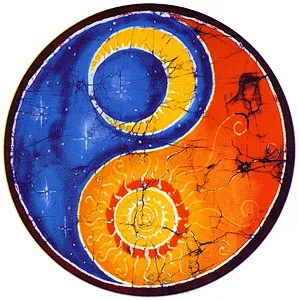

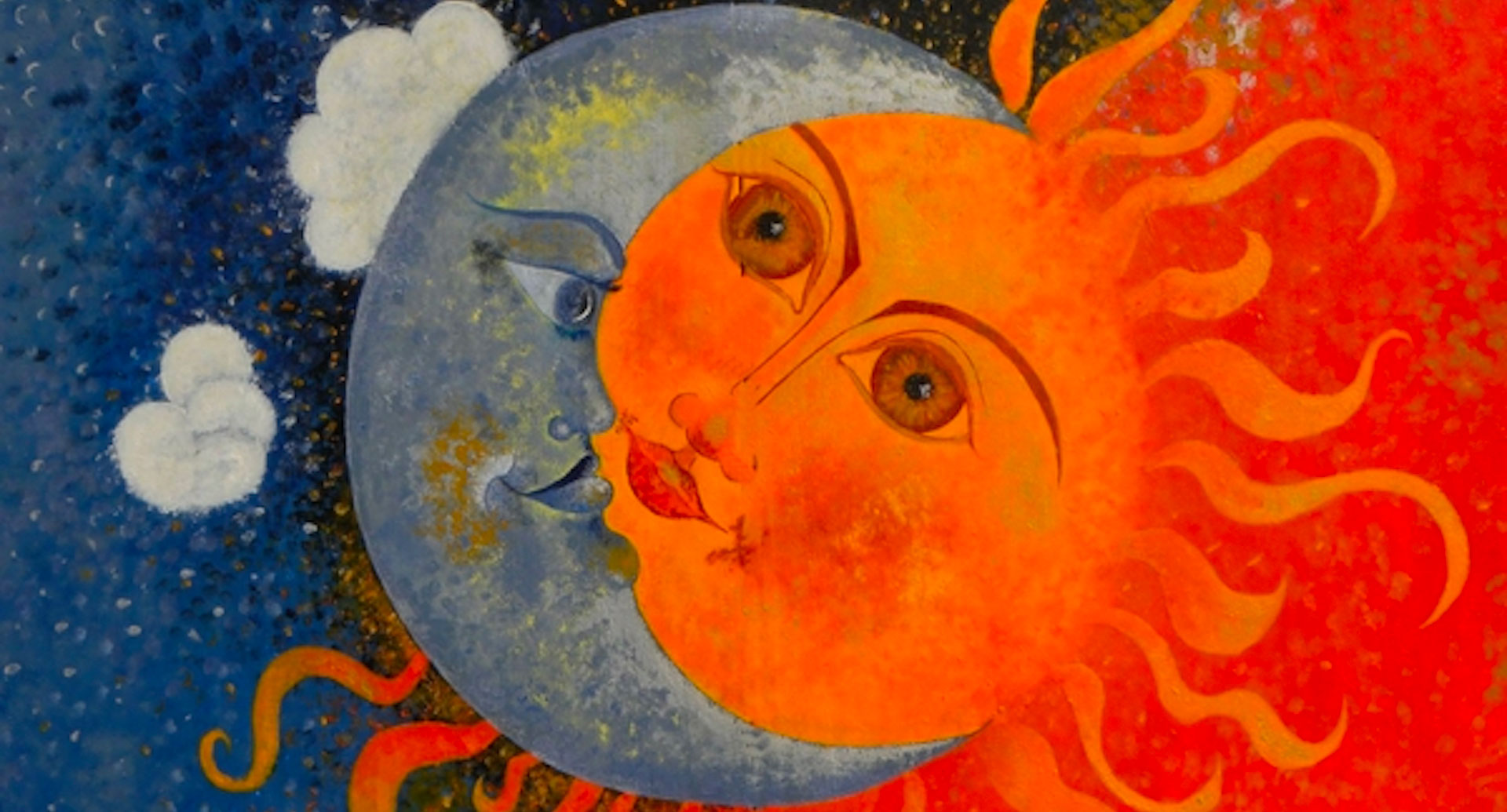
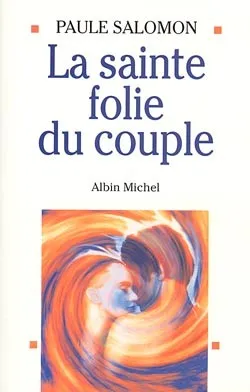
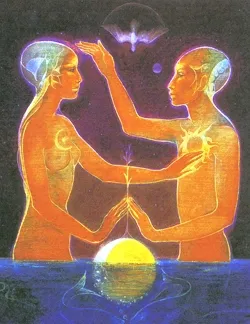
In her many books, the French writer Paule Salomon reminds us that thriving love can begin only after the inner couple has accomplished its marriage, once our masculine and feminine, our Shiva and Shakti, our Yang and Yin live, vibrate and celebrate fully in our psyche. Freed from the drives of need and compensation, the accomplished self becomes androgynous. He·she opens himself·herself to joyful celebration with other beings like him·her, nourished by the inner union. Two beings don’t meet anymore, want but four,
instilling in their amorous dance all the freedom they want.
Paul Salmon speaks about solar women and lunar men. I admire the richness of the ontology about love she has, coming from years of research. This ontology inspires my own work in evolutionary consciousness where the question of the masculine and feminine holds a central place. Paule Salomon’s narrative also speaks to my own journey. I find myself in her words. Having your story spoken by another person than you doesn’t happen everyday
Here I would like to share a very beautiful passage of her book “La Sainte Folie du Couple” (the Holy Craziness of Couple). Paule Salomon details her vision of the lunar man better than what I could have written myself. It made me realize that one has to become either a solar woman or lunar man in order to experience love as I describe it in my series of articles “Sex, Sex, Sex“.
moment. They are very present in love, very “cellular”, like the solar woman. Their body is vibrant and they like to arouse the body of the other. They are wonderful lovers, independently of the size of their sex, their age and their vitality. They establish a skin to skin communication, a psychological contact, they seek a soul communion. They like to receive caresses and surrender, to slip into a feminine passivity, solicit the active side of the woman during love. The harmony between the two masculine and feminine principles allows them to meet an inner fullness that makes them experience love in a different manner. Feelings like possessiveness and jealousy draw away, as well as feelings of rivalry, of affirmation by domination. Needs evolve, pleasure levels too. The behavioral harmony doesn’t obey to a moral demand, but to an inner need, to a taste. It is a matter of cooperating with the other just like we cooperate with our self, with the same friendship and the same pleasure.
The poet appears, the one who makes words dance, the one who becomes inflamed by a glimpse of a smile, a curve of a hip, a prominent breasts, the one who grows flowers, the one who whistles when he sees a woman passing by, the one who eats colors, the one who draws perfumes, the one who dresses women’s bodies with the impalpable, the one who doesn’t know what to invent next to love again and again this inescapable femininity from Earth, from life, the woman and her soul.
But where is this terrifying warrior from patriarchy, the one who wants victory from all wars he creates in a repeated hurry as he fears inaction and his secret desire for contemplation? He stands still there, but his sword now serves the poet. He doesn’t dominate anymore. He has surrendered to other values than his own, he willingly comes into rest, the rest of the warrior. He keeps the fearlessness of the knight to invest himself in action.
The lunar man is free, on the path to liberty. He can deeply and intentionally commit into a relationship as well as he can step away from any commitment. However he has a part of him that remains implacably and consciously alone, wild, for ever rebel to any structure. He holds a happy and fertile solitude that allows him to contact his anima. Rabindranath Tagore describes this encountering in his last poems:
‘One day in spring, a woman came
In my lonely woods,
In the lovely form of the Beloved.
Came, to give to my songs, melodies,
To give to my dreams, sweetness.
Suddenly a wild wave
Broke over my heart’s shores
And drowned all language.
To my lips no name came,
She stood beneath the tree, turned,
Glanced at my face, made sad with pain,
And with quick steps, came and sat by me.
Taking my hands in hers, she said:
‘You do not know me, nor I you-
I wonder how this could be?’
I said:
‘We two shall build, a bridge for ever
Between two beings, each to the other unknown,
This eager wonder is at the heart of things.‘